|
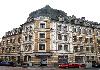
The building up for sale is part of the city's identity. It was built in the year 1898 in a very charming Wilhelminian style. It is a corner-house located on one of the most important arteries of the town and constitutes part of an architectural ensemble of four buildings, all of which were built in the same style between 1896 and 1898.
The living space is 695 square metres (7,481 square feet), divided up amongst eight apartments and a commercial unit. The commercial unit and one apartment are on the ground floor. There are two apartments on each of the first, second and third floors. The apartments are very well-designed, and their average size of 77 square metres (829 square feet) is a size in great demand. In the two attic storeys, which presently house one apartment plus store rooms for the tenants, three more apartments can be developed.
The last business of the commercial unit was an Asian snack-bar. In the twenties of the last century it had been a bookshop, and in the era of the GDR a post-office.
There is a cellar underneath the entire building (storage rooms for the tenants, scullery). The plot is 257 square metres (2,766 square feet), with a small courtyard in the rear. The structural fabric of the building is very solid. It was built by Bauhuette Greiz, which was famous throughout Thuringia on account of the excellent quality of its construction work.
The property is freehold.
At present the house is unoccupied since it is in need of renovation. The sanitary and electrical installations, in particular, are in need of replacement, and a heating system needs to be installed. The windows and doors need refurbishing or replacing, and the apartments need some more general arranging. Besides this, an horizontal barrier has to be fitted in the cellar against rising damp. For the entire renovation one calculates costs of 500 to 600 Euro per square metre of living space. The costs could be minimised by employing Polish workmen.
As the house is situated in a development area (»Stadtumbau Ost«), the state grants subsidies for the restoration. As yet in Greiz there have been granted up to 58 per cent of the total restoration costs.
Besides this, the German loan corporation for reconstruction, that is Kreditanstalt fuer Wiederaufbau (KfW), offers interest-favourable loans (2.8) for renovating old buildings (up to 50,000 Euro per residential unit). In addition, 95 per cent of all expenditure incurred in the maintenance of the exterior of the building such as external walls, roof, windows, etc. can be tax depreciated over a period of twelve years.
Inside the house there is a generously proportioned semi-circular granite stairway leading from the ground floor right up to the loft. In front of the apartment doors on all storeys there are attractive and well preserved Art Nouveau tiles. There is stucco in the building hall and in most of the rooms. In the old apartment doors there is grinded coloured glass.
The building is on the edge of the town centre where most of the sights are located, as well as shops, restaurants, civic offices, cinemas, post office, library, and so on. There are also schools and kindergartens within easy walking distance.
The rent index for Greiz rates the whole town as a very good place to live. The rents for apartments are stated as being up to 5.60 Euro per square metre. The rural district office with 650 employees is only 50 metres (55 yards) away from the buildings.
According to the urban planning manager, there are no vacancies in renovated houses. Greiz registers annually 600 persons moving in, and 1,500 persons changing their domicile within the town.
As in Greiz the urban areas of buildings made out of precast concrete slabs dating from the GDR era will be demolished, the demand for apartments will increase in the near future. Of all the federal regions in East Germany Thuringia records the lowest rate of unemployment and within the last year it has dropped more than ever before. |